Hayek was Right. Here's Why.
Issue No. 1

“We can't take money violently out of the hands of government. All we can do is introduce something they can't stop.” — Friedrich Hayek, 1984.
In 1984, an 85-year-old Austrian economist sat down for an interview and calmly described the future. Not as a prediction. As an inevitability. He'd spent fifty years watching governments debase currencies, manufacture booms, trigger busts, and transfer wealth from the many to the few, all through their monopoly control over money. He knew the only solution was separation. He also knew governments would never agree to it voluntarily.
So he looked for another way.
He died in 1992 thinking he'd lost the argument. He hadn't. He was just early.
The Argument Everyone Ignored
Hayek's core insight wasn't complicated. When a government controls the money supply, it controls who gets wealthy and who gets left behind. Not through policy, but through arithmetic.
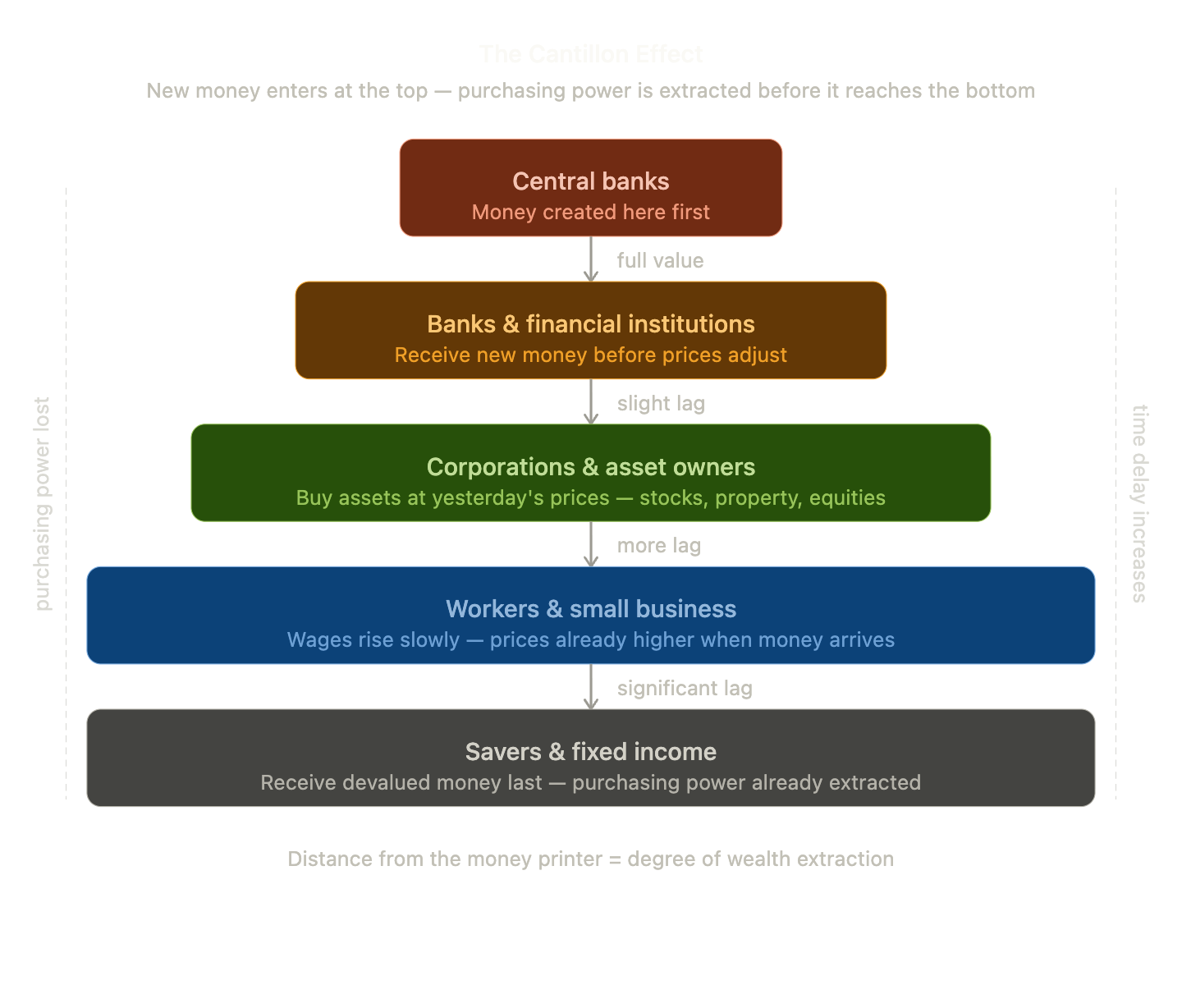
Here's how it works. New money doesn't appear everywhere simultaneously. It enters the economy at a specific point, through banks, through government spending, through bond markets. The people closest to that entry point receive the new money before prices have adjusted. They buy assets, property, and equities at yesterday's prices. By the time the money filters down to wages and savings, prices have already risen. The purchasing power has already been extracted.
This is the Cantillon Effect. Named after Richard Cantillon, an eighteenth century economist who described it three hundred years ago. It is not a theory. It is a mechanism. And it has been running continuously, in every fiat currency system, ever since governments took control of money.
Hayek understood this better than almost anyone. His solution was radical in its simplicity: take the monopoly away. Denationalise money. Let competing currencies emerge and let people choose. The best money would win. The worst, the ones governments used to fund wars and buy votes, would lose.
Nobody listened.
Why Every Previous Attempt Failed
It wasn't for lack of trying. People have been attempting to escape government money for as long as governments have controlled it.
Gold worked for centuries until 1933, when Roosevelt signed Executive Order 6102 and made it illegal for Americans to own it. The government simply confiscated the exit. Capital controls have been used to trap savings inside depreciating currencies from Argentina to Zimbabwe to Cyprus. SWIFT exclusions cut entire nations off from the global financial system with a bureaucratic signature. Every time a viable alternative emerged, governments found the lever that shut it down.
The pattern was consistent: find the chokepoint, apply pressure, problem solved. It worked because every previous alternative had a chokepoint. Gold had vaults. Wire transfers had correspondent banks. Even early digital payment systems had payment processors, company registrations, and CEOs who could be served with court orders.
Hayek's sly roundabout way needed to be something without a chokepoint. For most of his life, that thing didn't exist.
Something They Can't Stop
Imagine money with no issuer. No headquarters. No board of directors. No server that can be seized. Mathematically enforced rules that no government can override. A ledger maintained simultaneously across thousands of nodes in dozens of jurisdictions, such that switching any one of them off changes nothing.
Imagine that money is now being used autonomously by AI agents, software that transacts, settles, and moves value across borders faster than any regulator can respond, without asking permission from any financial institution.
You don't have to imagine it. It's already running.
The separation of money from state that Hayek described isn't a political movement requiring elections and legislation. It's a technical reality being assembled quietly, transaction by transaction, in the background of the existing financial system. Governments can slow it. They can regulate the on-ramps. They can make it harder and more expensive at the edges.
They cannot stop it. The chokepoint doesn't exist.
Why This Newsletter Exists
The Cantillon Effect has been running for decades. The people closest to the money printer, banks, asset managers, governments themselves, have grown extraordinarily wealthy. Everyone else has watched their savings quietly erode while being told inflation is under control.
That dynamic is ending. Not because governments have become more virtuous. Because the technical conditions Hayek was waiting for have finally arrived.
This newsletter tracks that transition. Not with price predictions or investment advice. With the economics of what actually happens when the most important financial infrastructure of the last century begins to lose its monopoly. Who wins, who loses, how fast it moves, and what it means for the rest of us watching from the edges of the global financial system.
Hayek was right. Nobody listened. Now it's too late to stop it.
— Waldo
The Cantillon Letter publishes weekly. If this resonated, subscribe and share it with one person who'd argue with it.